


Article by Rémi Lorrain
Vice-president Convergence – UnaBiz
What do you mean by convergence?
Convergence means ‘making IoT Ecosystems interoperable to remove frictions and complexity for end users to drive Massive IoT adoption’.
Convergence does not refer to the fusion of technologies, but to the collaboration between IoT technologies depending on use cases, which also applies to the mutual integration between existing terrestrial and satellite networks (monitoring of infrastructure, the environment, agriculture or utilities).
However, in many IoT applications, it is correct to choose a single IoT technology, the best for the application to be made of it.
Convergence is a customer-centric approach that supports IoT customers in collecting data and solving business challenges, regardless of the IoT technology they choose.
UnaBiz positions itself as an IoT system integrator able of offering the most relevant IoT technology (Sigfox, LoRaWAN, Cellular, Wifi, BLE…) or Convergence, i.e. different IoT technologies, guaranteeing integration between device and application.
Why is Convergence important and what problems does it solve?
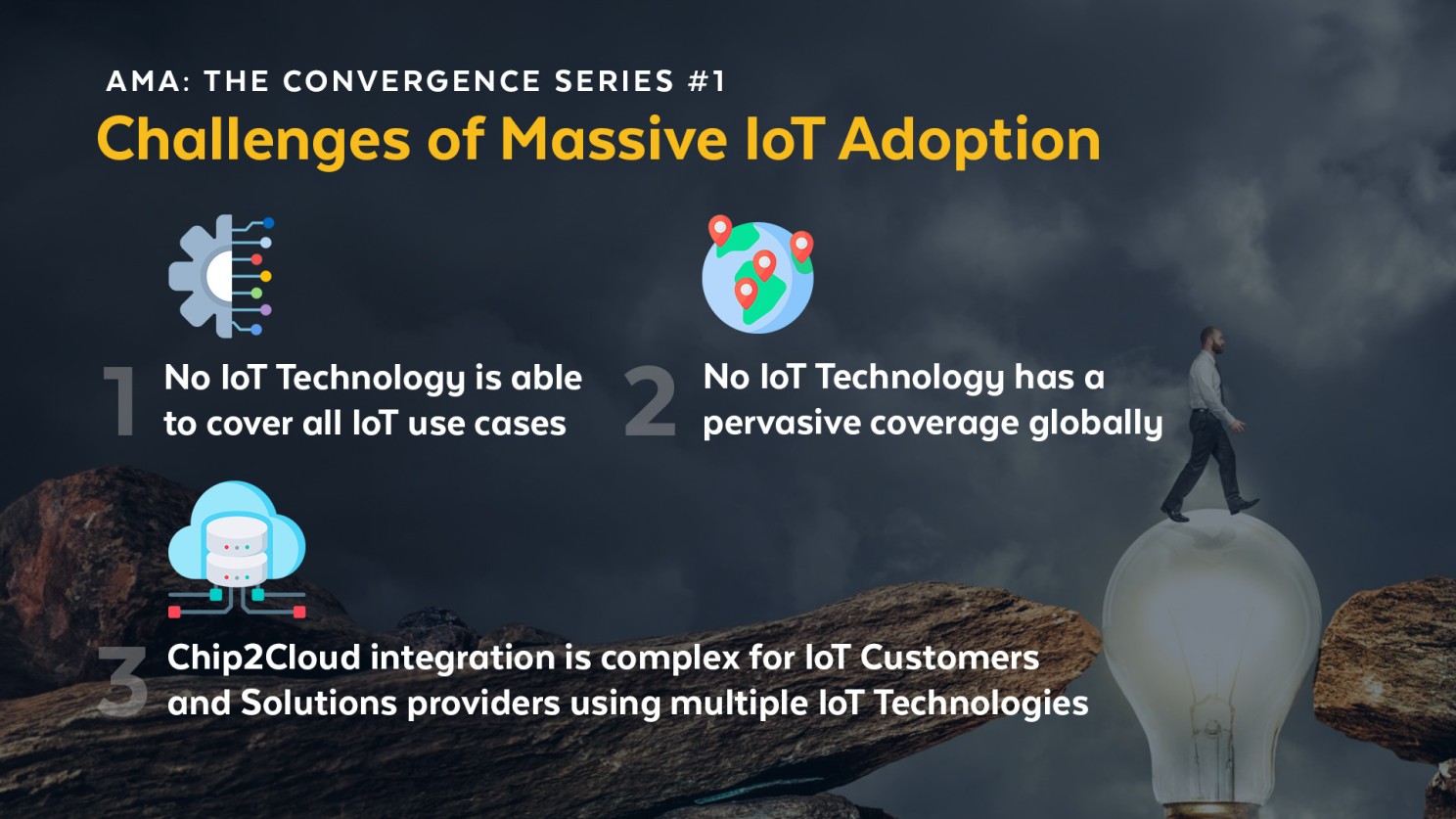
Convergence, also known as ‘the ability to combine different IoT technologies’, aims to solve three key business challenges, supporting the growth of the IoT market:
1. No IoT technology can satisfy all IoT needs.
2. No IoT technology has widespread coverage globally.
3. End-to-end integration (from chip to cloud -) is complex for IoT customers and solution providers using different IoT technologies.
Convergence is happening now because…
- Each IoT technology has spent years promoting its adoption and identifying its strengths.
- Each IoT technology has successfully covered most of its most relevant use cases and is now experiencing limitations in trying to approach new use cases.
- Market needs have evolved over time, moving from local to more international projects, from urban areas to suburban and remote areas that require satellite coverage that can be integrated with others, and from a single use case to several use cases for every IoT customer.
- IoT customers have traveled the IoT experience curve and discovered that no single IoT technology fits all.

What are the benefits of Convergence for IoT customers
- Easier and more cost-effective integration and management of different IoT technologies, giving you access to more IoT use cases.
- Expanded coverage for some use cases such as asset tracking, water metering or agriculture.
- Greater network resilience and higher communication capacity, with the concomitant use of LPWA (Low Power Wide Area) IoT networks, such as Sigfox, LoRaWAN and Cellular (for example in smart metering applications).
- Access to technology-agnostic middleware and vertical platforms to simplify IoT Operations and make the most of data collected from the field thanks to different IoT technologies.
What are the advantages for the IoT ecosystem (manufacturers of devices, modules and solutions, as well as system integrators)
- Reduce investment risk by combining different IoT technologies (a single product that allows the use of multiple LPWANs).
- Access a broader market by implementing hybrid modes (Sigfox, LoRa and Cellular) and leveraging multiple ecosystems.
