



Convergence - part 2
Article by Rémi Lorrain
Vice-president Convergence – UnaBiz
Where can convergence be applied?
Convergence can be applied across the entire IoT value chain, including “Devices”, “Network & Connectivity”, “Middleware” and “Vertical Applications”, depending on the business need.”
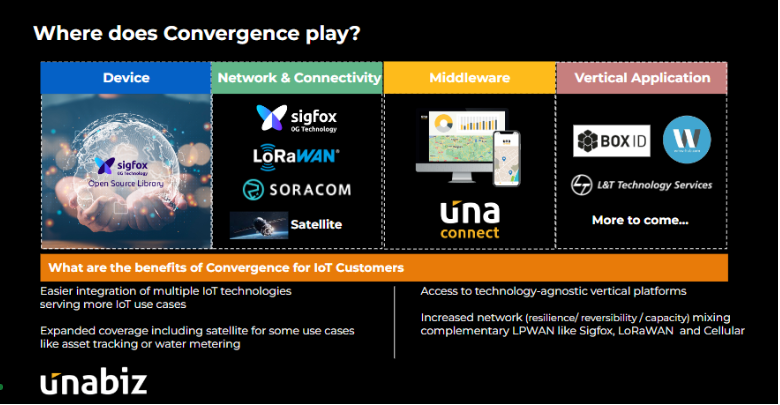
Where does Convergence fit in and what is Unabiz's role in Convergence?
Convergence can be applied across the entire IoT value chain, including ‘Device’, ‘Network and Connection’, ‘Middleware’ and ‘Vertical Applications’, depending on the business case and actors involved, and is used when it is necessary to bring value to the customer.
Convergence at the vertical application level
In this scenario, a unique platform for vertical applications can collect IoT data from different IoT technologies, such as Sigfox, Cellular, LoRaWAN, Satellite, WiFi, RFID and Bluetooth, and presents IoT data to end users in the most convenient way. For example, UnaBiz offers BOX ID for logistics, an independent data management technology platform dedicated to the logistics sector. Convergence in Vertical Applications is a rapidly growing trend in the IoT market.

Convergence at the network and connectivity level
On the one hand, network convergence, involving radio gateways that enable multiple Low Power Wide Area Network (LPWAN) technologies, has not been a primary focus in the current IoT market thus far. This is because, in many situations, it was more convenient to place separate LPWAN gateways on the same towers. However, in the medium/long term, we expect a change in market conditions and the consequent emergence of hybrid gateways thanks also to the growing demand for more economically advantageous hybrid radio networks.
On the other hand, connectivity convergence, leveraging roaming capability, is managed by multiple IoT service providers globally. Mobile virtual network operators (MVNOs) selling aggregated cellular connectivity are the creators of connectivity convergence. UnaBiz partners with SORACOM to provide cellular connectivity globally and plans to soon add LoRaWAN terrestrial and satellite connectivity as well. Additionally, Unabiz offers Sigfox 0G connectivity and Sigfox 0G network coverage to all LPWAN ecosystems.
Unabiz is focused on promoting “connectivity convergence” by anticipating the next step towards connecting multiple LPWAN ecosystems.
Convergenza a livello middleware
La piattaforma middleware Unabiz, nota anche come UnaConnect middleware, consente ai clienti IoT di gestire le proprie flotte di dispositivi IoT e garantire l’archiviazione sicura dei dati IoT, indipendentemente dalla tecnologia di connettività IoT utilizzata, sia essa Sigfox, LoRaWAN, Cellulare o Satellite.
Il prossimo passo per la convergenza del middleware sarà interconnettere in modo “seamless” i network core LPWAN, ad es. Backend Sigfox, i server di rete LoRa, la rete cellulare 5G e potenzialmente altre tecnologie IoT come il WiFi. Tutto si baserebbe su uno schema di “identità unificata del dispositivo”.
The convergence of devices

The most immediate form of convergence is device convergence as it allows a single device to connect multiple LPWAN networks. Device and solution manufacturers have the opportunity to design and produce a single product “SKU” (a single “hardware and firmware” device that supports multiple LPWAN technologies). This approach prevents the risk of investing in multiple SKUs and allows access to a broader IoT market.
It should be remembered that the Sigfox 0G radio protocol is now open source: the Sigfox 0G library can now be integrated into most modules and chipsets available on the IoT market.
Recently, Unabiz also partnered with Semtech to accelerate the implementation of the chipset in hybrid LoRa and Sigfox mode (i.e. a single device that is capable of communicating with Sigfox and LoRaWAN) by enabling Sigfox in the LoRa Edge and LoRa Connect platform. This collaboration aims to industrialize the implementation of Sigfox 0G technology on Semtech’s LoRa Edge and LoRa Connect LRxx chipsets. This dual-mode scheme is also available on ST Microelectronics ST Micro Sigfox and LoRaWAN chipsets.
Furthermore, manufacturers of LSM1110A SJI multiple modules and hybrid devices Adeunis Sigfox and LoRaWAN already implement hybrid mode.
Sigfox has also been massively implemented in a hybrid LTE-M/Sigfox device solution in Japan for NICIGAS.
In conclusion
To conclude, convergence is an added value for customers and we must keep in mind that:
• Convergence is used only if necessary. In many use cases, a single technology still represents the most effective approach
• Convergence can be applied to any part of the IoT value chain (device, network, connectivity, middleware and IoT applications)
• Convergence is primarily used to solve key IoT challenges:
– Address different use cases
– Expand network coverage and performance (SLA, reliability, reversibility, capacity)
– Simplify the integration of multiple technologies
– Optimize TCO
– Maximize investments by device and solution manufacturers
Contact EIT Smart to understand how you can be part of this global revolution! Write an e.mail to info.eitsmart@eitowers.it.

Convergence - part 1
Article by Rémi Lorrain
Vice-president Convergence – UnaBiz
What do you mean by convergence?
Convergence means ‘making IoT Ecosystems interoperable to remove frictions and complexity for end users to drive Massive IoT adoption’.
Convergence does not refer to the fusion of technologies, but to the collaboration between IoT technologies depending on use cases, which also applies to the mutual integration between existing terrestrial and satellite networks (monitoring of infrastructure, the environment, agriculture or utilities).
However, in many IoT applications, it is correct to choose a single IoT technology, the best for the application to be made of it.
Convergence is a customer-centric approach that supports IoT customers in collecting data and solving business challenges, regardless of the IoT technology they choose.
UnaBiz positions itself as an IoT system integrator able of offering the most relevant IoT technology (Sigfox, LoRaWAN, Cellular, Wifi, BLE…) or Convergence, i.e. different IoT technologies, guaranteeing integration between device and application.
Why is Convergence important and what problems does it solve?
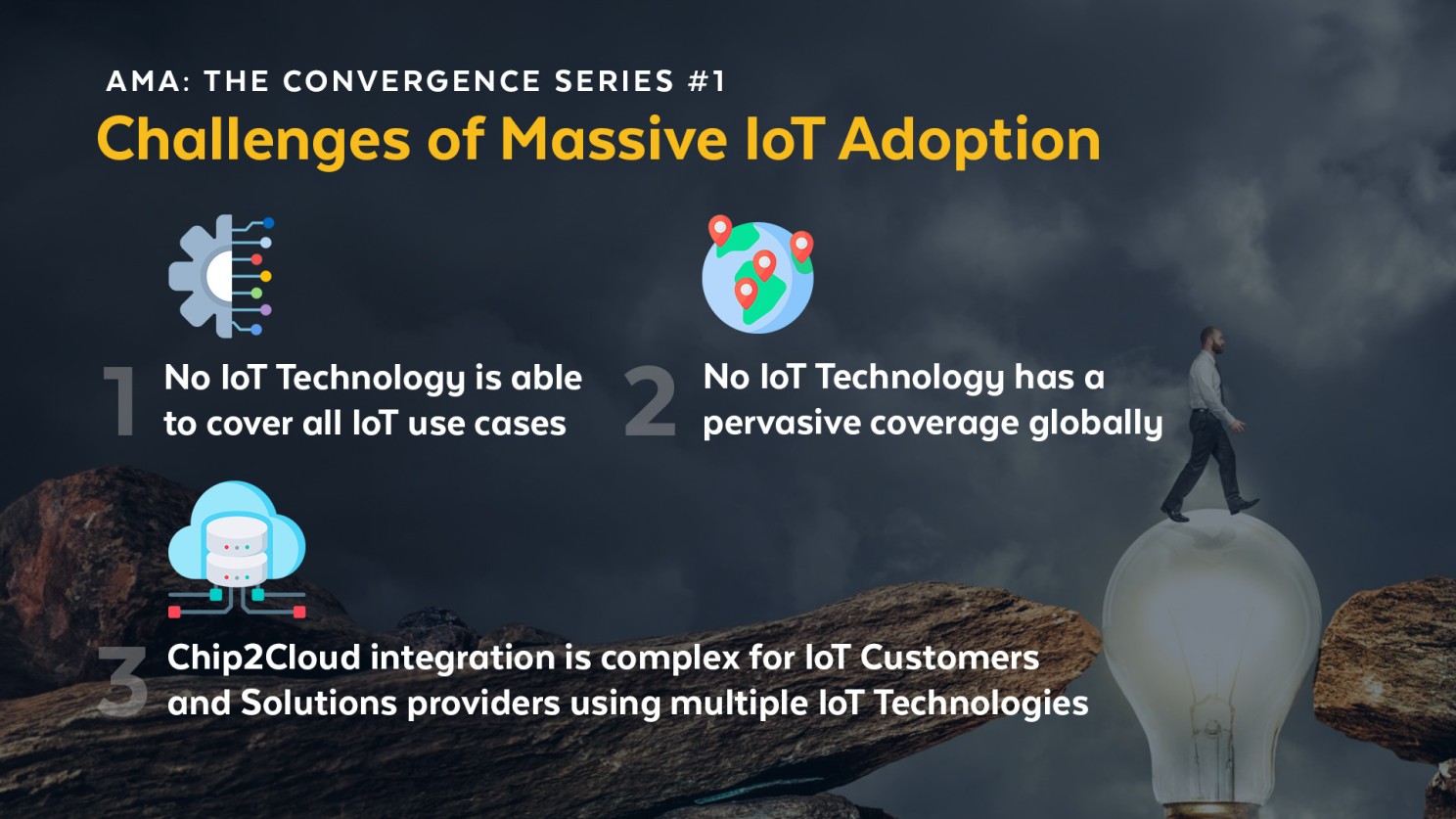
Convergence, also known as ‘the ability to combine different IoT technologies’, aims to solve three key business challenges, supporting the growth of the IoT market:
1. No IoT technology can satisfy all IoT needs.
2. No IoT technology has widespread coverage globally.
3. End-to-end integration (from chip to cloud -) is complex for IoT customers and solution providers using different IoT technologies.
Convergence is happening now because…
- Each IoT technology has spent years promoting its adoption and identifying its strengths.
- Each IoT technology has successfully covered most of its most relevant use cases and is now experiencing limitations in trying to approach new use cases.
- Market needs have evolved over time, moving from local to more international projects, from urban areas to suburban and remote areas that require satellite coverage that can be integrated with others, and from a single use case to several use cases for every IoT customer.
- IoT customers have traveled the IoT experience curve and discovered that no single IoT technology fits all.

What are the benefits of Convergence for IoT customers
- Easier and more cost-effective integration and management of different IoT technologies, giving you access to more IoT use cases.
- Expanded coverage for some use cases such as asset tracking, water metering or agriculture.
- Greater network resilience and higher communication capacity, with the concomitant use of LPWA (Low Power Wide Area) IoT networks, such as Sigfox, LoRaWAN and Cellular (for example in smart metering applications).
- Access to technology-agnostic middleware and vertical platforms to simplify IoT Operations and make the most of data collected from the field thanks to different IoT technologies.
What are the advantages for the IoT ecosystem (manufacturers of devices, modules and solutions, as well as system integrators)
- Reduce investment risk by combining different IoT technologies (a single product that allows the use of multiple LPWANs).
- Access a broader market by implementing hybrid modes (Sigfox, LoRa and Cellular) and leveraging multiple ecosystems.

IoT and security with EIT Smart and 0G technology
There are many fields impacted by Internet of Things (IoT) innovation, from industry to Smart cities, from logistics to utilities, up to infrastructure monitoring and Smart Buildings. There are now several billions of connected devices in the world, but how can data integrity, security and resistance to interference be guaranteed?
0G technology guarantees security and signal robustness
Within the Low Power Area Network (LPWA) cluster, 0G technology based on Sigfox protocol has brought life to a new era in the Internet of Things sector in terms of security and communication robustness.
0G technology was designed to address the requirements of “massive LoT”, focusing on energy efficiency to ensure long battery life, wide communication range, high network scalability, as well as simplicity and short time to market. It integrates distinctive technical features with a global business model, with the aim of connecting the physical world gathering data from connected devices with ease and efficiency, especially when self-powered.

High resistance to interference and jamming

With the growth of applications diffusion, the topic of security in the IoT sector takes on a central role to ensure the integrity and reliability of the solutions adopted. However, talking about security along an extended value chain as the IoT one requires to address various aspects that vary from the device to the final software application, passing through the communication network. And it is precisely on this last aspect that the UNB (Ultra Narrow Band) wireless communication protocol of 0G Sigfox technology provides several advantages compared to traditional communication networks.
The UNB protocol, in fact, due to its intrinsic characteristics and design, appears to be particularly resistant to interference; the signal can therefore be used from an “anti jamming” perspective as it is not influenced by common frequency jammers. The effort necessary to disturb the network to the point of completely denying its service is in fact infeasible as it would require military technologies.
This characteristic is given by the combination of:
- Asynchronous communication: By design, a Sigfox device is never directly connected to Internet and do not communicate using the internet protoco. In fact, Sigfox devices have a built-in behavior. When this behavior requires that data is transmitted to or received from the internet, the device broadcasts a radio message. The burden of receiving the data is therefore completely upon the network. If the device requires a response, the IoT application has the opportunity, during a limited time window, to deliver the response to the device through the Network. While on the one hand this feature ensures the security of the device which is therefore shielded from the internet by a very strict firewall, on the other hand it makes it difficult to inhibit the transmission of data.
- Redundancy and special diversity: every message sent as described above is received by every base station in the communication range. This redundancy in reception, together with the sending of multiple copies of the same message, makes it very difficult and expensive to inhibit reception.
Moreover the Ultra narrow band protocol makes the signal more “robust” and able to overcome a higher noise threshold compared to other LPWA protocols.
These characteristics, together with message authentication and replay avoidance measures, with the possibility of implementing secure elements at device level or for example the verification of the integrity of the message, ensure high resistance and robustness of communication.
EIT Smart is the only Sigfox operator in Italy
EIT Smart, a company of the El Towers Group, is the only Sigfox Operator in Italy, and manages a cutting-edge network infrastructure based on 0G technology which allows to cover efficiently wide areas. EIT Smart is able to guarantee international interoperability by integrating seamlessly into the networks of other operators who use the same 0G Sigfox communication standard. EIT Smart also ensures interoperability with other LPWA technologies through convergence.
Discover the network’s live coverage: https://eitsmart.eitowers.it/0g-network-operators/.

EIT Smart, IoT and location data: the case of Konvoy Group
In the field of logistics, so-called localization solutions are increasingly taking hold. What are we talking about? We are talking about new IoT sensor devices that allow goods, assets or people to be located within a given operational context, providing extremely useful data to better plan, direct, execute and measure activities. All for the benefit of visibility, control, efficiency, and productivity.
Consider the benefits of always being able to know where assets are and what state they are in.
For example, in logistics, where are vehicles or containers? Are they moving or stationary? Full or empty? How long have they been there? At what temperature have they been transported? Having visibility into assets enables you to better manage your operations and make logistics and in general supply chain management processes more efficient.
Asset tracking made easy with EIT Smart and Sigfox
Having an overview of one’s assets, locating them even outside national borders, is simple and within everyone’s reach, thanks to the new sensors (trackers) that integrate the Sigfox protocol and communicate thanks to the 0G network, which in Italy is managed by EIT Smart, the only national 0G network operator able to guarantee international interoperability by interconnecting with the networks of the other 72 operators in the “0G Network.”

The strengths of Sigfox technology
Sigfox technology is a Low Power Wide Area Network (LPWA) (low power and long range) and is based on the Ultra Narrow Band (UNB) communication protocol. This protocol enables new applications characterized by security, low power consumption, ease of use, and low-cost wireless connectivity by making it possible to add connectivity to objects (assets, containers, goods, etc.) not yet connected.
This new IoT technology turns out to be a winner when compared to short-range technology solutions (BLE, RFId, etc.), which provide a good solution for asset tracking but only in limited spaces, and is also better than cellular solutions, which are more energy-intensive, jammable and more expensive and complex to manage globally.
The information that these new trackers send over the 0G network is the location of assets, status and transport conditions, supporting the calculation of indicators such as the level of asset utilization or estimated time of arrival.
In the beverage sector, IoT revolutionizes the world of drum rental: the Konvoy Group case
Track&trace applications can bring benefits to all sectors, including the beverage sector. This is demonstrated by the case of the Konvoy Group, an Australian provider of keg rental solutions for the beverage industry, which chose to track and monitor 70,000 beer kegs with an IoT solution in Sigfox technology on a 0G network.
The advantages are real and obvious. The data coming from the field becomes precious information that allows you to save time and resources, optimize and make activities and movements more efficient. IoT technology also allows the Konvoy Group and its customers to solve the problem of lost kegs and optimize their keg fleet.
The 0G network also enables data to be transmitted even over long distances and between multiple countries, a fundamental element for the Konvoy Group which operates in Australia and New Zealand.

More than anything, we wanted to offer real-time information and high visibility to manufacturers and drum rental companies about their fleet and enable them to not only reduce asset losses but also optimize drum usage,” explains Adam Trippe-Smith, Founder and Director of the Konvoy Group. “We were looking for a robust, low-cost tracking solution that would last at least five years. Initially we focused on localization, but then this solution gave us the opportunity to also monitor the temperature of the drums. In the beer industry, for example, leaving a keg at high temperatures can ruin the product. Being able to send an alert to our customers to inform them that their keg was transported at the right temperature is an important advantage for them.”
Adam Trippe-Smith – founder and Director of the Konvoy Group
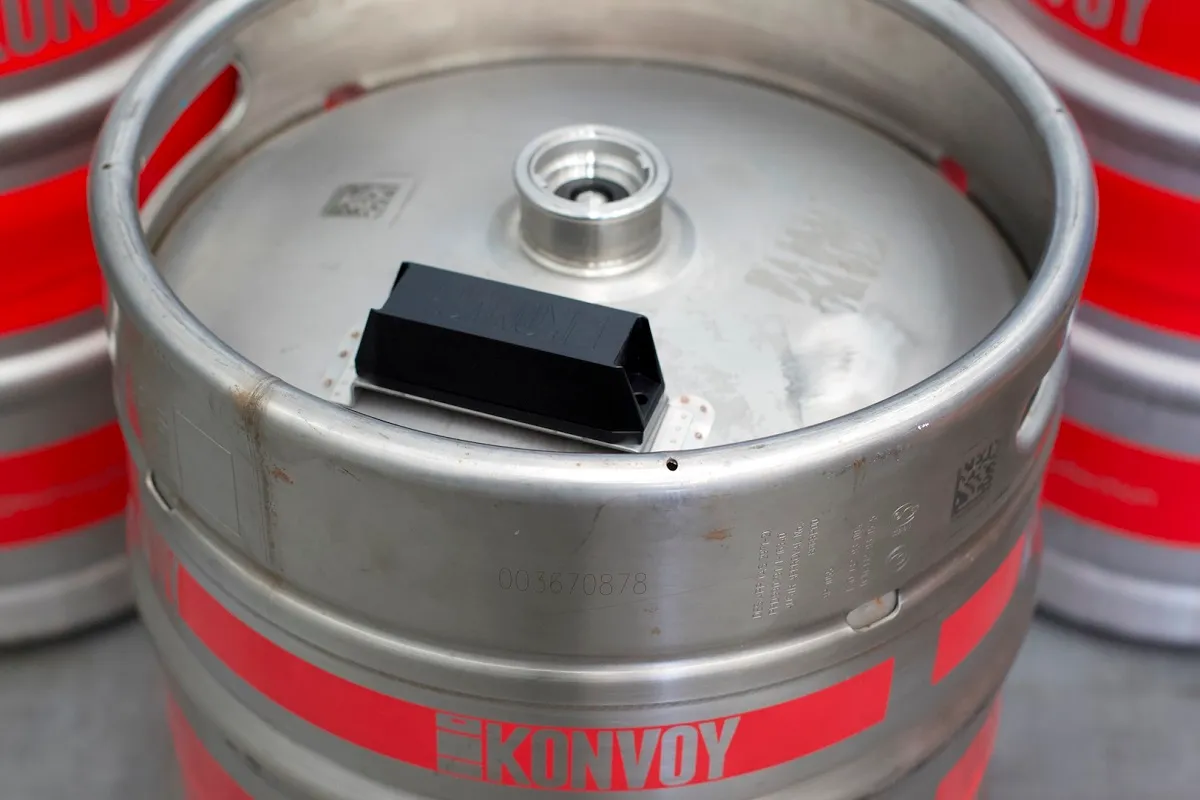
The IoT trackers used to locate the Konvoy Group’s fleet drums are small, battery-powered devices, programmed to send location data via the 0G network at regular intervals or based on specific events. Thanks to low energy consumption, each sensor can last up to 5 years transmitting position and temperature information several times a day and it does not require frequent maintenance. In addition to tracking, an accelerometer with algorithms has also been integrated into the tracker to detect different types of movement during the life cycle of the drum, so it knows, for example, when drums are moved or cleaned.
Konvoy started by managing its own fleet, later the business expanded and also became a point of reference for other keg owners. Today Konvoy manages over 200 rental customers and has already installed 70,000 devices on its drums, equipping 95% of its fleet in Australia and New Zealand.
How does drum detection work?




Where is my keg?
Has the load been moved?
Has the temperature of the beer changed?
Has the drum been cleaned or filled?
The numbers behind visibility along the Supply Chain


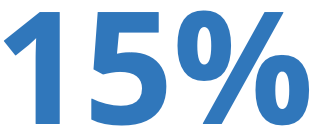
Increased level of asset use
Reduction of handling and administrative costs
Reduction of drum loss
Reduction in circulating fleet

EIT Smart and Draco for monitoring infrastructure and roads
The topic of monitoring roads and infrastructures is very relevant, and is linked to maintenance and safety needs. The need to carry out comprehensive checks on all infrastructures present in the area has in fact led to the start of a revolution in the monitoring and inspection systems of bridges, viaducts and tunnels. Monitoring roads and infrastructures means collecting and processing data, via sensors that are installed on these structures, to check their status and plan maintenance activities, thus guaranteeing their safety.
EIT Smart, a company of the EI Towers Group and national LPAWN operator in 0G technology on the Sigfox protocol, opens a new era in the Internet of Things (IoT) sector for infrastructure monitoring, allowing for the creation of innovative “made in Italy” solutions such as Draco’s.
The Draco monitoring system
Predictive maintenance and monitoring today have a small, great ally: it’s called Draco and it is an innovative, non-invasive, widespread and sustainable digital controller, already in use to monitor Italian roads.
The Draco system was developed and marketed by Vita International in collaboration with EIT Smart and Sigfox. AstepON also participated in the initiative. It is an automatic alert system with remote management, based on IoT technology, which verifies, for pre-established time intervals, any changes in the tightening torque of the anchors to the foundation of various road protection devices or even traffic information, through the use of instrumented washers.


The Sigfox protocol is used for data transmission, which allows information to be conveyed in real time through a dedicated cloud platform. The solution does not interfere with the behavior of the devices, think for example of an integrated safety-anti-noise barrier, therefore it does not in any way affect the CE marking.

The Draco sensor
The Draco sensor is used, for example, in monitoring the anchor bolt, i.e. the plate with threaded bar to which the foundation is generally anchored, for example, of an integrated safety-anti-noise barrier (but also of a normal acoustic barrier, as well as a portal for variable message signs or a fence on a ramp). An instrumented washer can now be placed in the existing thread right under the pair of tightening nuts, i.e. a very discreet and smart device containing a sensor in turn connected to an electronic card for data transmission. Its task: to measure the deformations induced by the compression force generated by tightening the nuts of the anchor bolt itself. Thanks to Draco, that particular point of our road network – on which the stability of a key piece of equipment such as an integrated barrier or a portal or a protective net depends – becomes controllable, not only through dedicated visual inspection, as has happened so far, but through a totally automated system and 24 hours a day.
The advantages of Sigfox for road and infrastructure monitoring
In the world of the Internet of Things, Low Power Wide Area Networks (LPWA), to which Sigfox also belongs, are becoming a point of reference.
Within the Low Power Area Network (LPWA) cluster, Sigfox is characterized by simplicity, resistance, low emissions and low energy consumption, thanks to the characteristics of the Ultra Narrow Band protocol.
In fact, the protocol allows data to be brought to the cloud, not through the traditional mobile telephone networks, but by using a new network dedicated to the IoT managed by EIT Smart. The communicating object in Sigfox is not connected to a specific base station, but the transmitted message can be received by any base station located in the vicinity of the range.
Sigfox thus allows data to be transmitted even over large communication distances, such as those of the roads and infrastructures of the Italian territory, guaranteeing a high scalability of the network, thanks to the penetration of the signal and the high number of nodes managed per single station
Sigfox consente così di trasmettere dati anche su grandi distanze di comunicazione, come possono essere quelle, appunto, delle strade e delle infrastrutture del territorio italiano, garantendo una alta scalabilità della rete, grazie alla penetrazione del segnale e all’alto numero di nodi gestiti per singola stazione.

Reliability and security of EIT Smart and the Sigfox network
In terms of security, Sigfox is reliable thanks to its unique features that guarantee high resistance to jamming and interference. It is also easy to install and manage thanks to the absence of cabling and the availability of the Sifgox Beckend. All this enables to monitor works distributed across the territory in a simple and effective way via self-powered sensors.
As Sigfox Operator in Italy, EIT Smart is the only operator able to provide the benefits of this technology, combined with global interoperability between the networks of all Sigfox partners using the same OG communication standard in over 70 countries in the world.

EIT Smart and the right technology for IoT project: “less is more”
They say that data is the “new oil” and that the difference lies in knowing how to collect it in a cost-effective manner and efficiently. EIT Smart offers the right technology to do this.
They say that data is the “new oil” and, for large companies and SMEs who want to extract value from it, the difference lies in knowing how to collect it in a cost-effective manner and efficiently.
The value of the data
We have been talking about the value of data and Big Data, AI and IoT applications for some time now but for companies that produce goods or provide services, whether they directly manage their own equipment or rely on third parties, the challenge no longer consists in having a large amount of data available, but rather in possessing the ability to collect and exploit it in the best way possible, from an operational perspective, to improve the reliability, effectiveness and efficiency of its processes or to innovate its offer.
The “small data”
Every area of application and every smart and 4.0 project is different, and it is therefore important to know how to choose the right data collection technology for your need, keeping in mind that having “lots” of data is not necessarily synonymous with success. In fact, it is often sufficient to have a smaller amount of information provided it is what is needed, accurate, contextualized, and collected effectively at the right time.
From even a “small” but focused dataset, it will be easier to reprocess the information to extract value so much so that the term “Small Data” was introduced to express this concept, thus contrasting with “Big Data.” To get great results sometimes all it takes is a little data, but “good” data: #smalldatabigresults.

“Less is more”: when too much data is not needed
Even in technology, innovation and business, the saying “Less is more” applies. Indeed, there are areas of application in which it is enough to correctly collect just one parameter, or to periodically monitor small data set in the right way, to transform one’s business.
This is the case, for example, of the PSA Group, which launched a project on Sigfox technology in 2019 to monitor the location of components at more than 2,000 European sites along its Supply Chain, or Coyote, a company specializing in locating and recovering stolen vehicles that has introduced the same technology in its trackers to increase the recovery rate of vehicles thanks to jamming resistance. In both cases, in fact, the location data is not processed continuously, but by adapting the frequency of acquisition according to need, on a scheduled or motion basis in the first case and in case of theft in the second.


Many companies embarking on a digital transformation journey tend to assume that having lots of data will help them solve their business problems. This is not always the case: the real added value is being able to collect and read the data which is really necessary for your business among the thousands of pieces of information in a simple and cost-effective way.
Not to mention that the size of Big Data could create further challenges for businesses, including security and privacy risks, lack of professionals and analysts and difficulties in archiving and processing.
In short, it is about ensuring that data and analysis end up in the right hands at the right time so that they can be used as a basis for making the right decisions, contributing to the achievement of company’s objectives.
0G: the technology created for “small data”
In this context, 0G technology on the Sigfox protocol opens a new era in the field of the Internet of Things from a “small data” perspective. Low Power Wide Area Networks (LPWAN), of which Sigfox is the leader, have in fact now acquired a well-defined role in the technological panorama of the IoT world.
0G technology, combining the characteristics of LPWANs with those specific to the Sigfox protocol, enables applications based on security, low energy consumption, ease of use and low-cost wireless connectivity, making it possible to add connectivity to objects (assets, containers, goods, etc.) not yet connected. 0G technology is perfect for covering distances of tens of kilometers and is present in over 70 countries around the world and thanks to the global interoperability between the networks of all Sigfox operators, it guarantees continuity of service at an international level.

EIT Smart and 0G technology for data collection
As Sigfox Operator in Italy, EIT Smart – a company of the EI Towers Group – is the only national operator capable of offering the advantages of this technology to companies for simple applications based on the exploitation of a defined set of data such as, for example, the position (for tracking), the status (for security systems), or a measurement (for metering and infrastructure monitoring).
As concerns the network, the advantages of 0G technology from a “small data” perspective are numerous, starting from requiring “only” a streamlined and convenient analysis and storage infrastructure.
As concerns the object, the main advantage is the long battery life of self-powered sensors which will have a significant impact on the Total Cost of Ownership of the technology used. The cost is the result of three different variables: frequency, availability, and accuracy.
Having “less data” therefore means optimizing the total cost of the proposed solution and implementing “ad hoc” technologies specially designed for this purpose and completely different from those that would be chosen to obtain a large amount of data. In this case, 0G technology turns out to be a winner when compared to cellular and satellite technologies, which are more energy-intensive and complex to manage.

EIT Smart, the company of EI Towers group dedicated to IoT
EIT Smart is a company of the EI Towers Group capable of developing and managing cutting-edge network infrastructures and innovative IoT projects based on LPWAN networks.
EIT Smart, IoT Service Provider & Integrator, is a company of the EI Towers Group, which offers its experience and “know how”, acquired in the management of TV, radio and telecommunications infrastructure, to the Internet of Things world.
The company is able to develop and manage cutting-edge network infrastructures and innovative IoT projects based on LPWAN (Low Power Wide Area network), mainly on the 0G technology of Sigfox and also LoRaWAN.
The advantages of 0G technology
0G technology provides numerous advantages over traditional communication networks:
- simple to use
- secure
- low cost
- very low energy consumption
- very low electromagnetic impact

Data from the Internet of Things Observatory of the Polytechnic of Milan
The Internet of Things is now a consolidated reality in Italy. According to data collected by the Internet of Things Observatory of the Polytechnic of Milan, the market is healthy and continues to grow by +13% compared to 2021, reaching 8.3 billion euros, despite the problems due to the shortage of raw materials and semiconductors, as well as the economic and political instability of the conflict in Ukraine. In 2022, there were 124 million IoT connections active in Italy, of which 68% were represented by connections enabled by non-cellular technologies. Among these, Low Power Wide Area Networks (LPWAN) emerge, growing significantly by +20% reaching 2.4 million connections and increasingly becoming a point of reference for the technological evolution of the IoT world.
Sigfox 0G technology is placed precisely in the category of LPWAN networks, specifically designed to efficiently collect data from sensors distributed across the territory.
The areas of application of EIT Smart’s IoT projects
The areas of application of intervention of EIT Smart are potentially unlimited and transversal:

Tracking and logistics

Security services
Utilities and energy services

Road and infrastructure monitoring

Smart buildings and smart cities

Environmental and land monitoring

Smart agriculture
