


In recent years, also following the Covid-19 pandemic and the increase in air pollution, there has been an increasingly growing attention towards indoor air quality and the measurement instruments connected to it.
Among the most promising developments in technology is the possibility of have simple and easily installable tools able to monitoring the air we breathe.
In fact, until a few years ago, the analysis of air pollutants was the prerogative of very expensive systems, extremely complex to use and large, such as the urban monitoring stations used by institution like ARPA.
Over the last few years, there has also been an increase in monitoring devices, with an ever-increasing miniaturization of sensors, reducing costs and dimensions while maintaining excellent analysis capacity. We have thus moved from complex and bulky instruments to sensors with an affordable cost and use affordable for everyone.
This is the frontier of the Internet of Things (IoT) paradigm, which today offers the possibility of having tools capable of communicating independently with the network, which can be used to obtain information on the world around us.
Monitoring indoor air quality
Not just the fresh air is polluted. Even the air you breathe every day at home, as well as at work, can be contaminated by various biological, chemical and physical sources of pollution, which are harmful to the body in the long run. A contaminated space can compromise the well-being of those who live and work in a confined environment for a long period of time. Indoor air comes from the external air of the atmosphere and, in the absence of adequate natural and/or artificial ventilation, its quality inevitably tends to deteriorate.
In industrialized countries and, in particular, in urban environments, the population spends more than 80% of their time indoors, i.e. at home, office, car and in places of education such as schools and universities.
Numerous studies, including those conducted in Italy in recent years by Sima, the Italian Society of Environmental Medicine, demonstrate that the presence of pollutants in the air we breathe is correlated to the development of various pathologies. In particular, levels of harmful substances can be measured above the threshold of attention established by the World Health Organization. Measure them has therefore become a strict necessity in different contexts, homes and workplaces above all.
We all know that clean and healthy air guarantees health and well-being and avoids the onset of symptoms such as: drowsiness, headaches, exhaustion, lack of concentration, burning eyes, breathing difficulties such as throat and nose discomfort, asthma and allergies.

Measuring well-being and comfort thanks to sensors and data
Air quality sensors today can detect a large amount of contaminants in the air, such as particles, pollutants and harmful gases that are damaging to health. They are used in various applications such as health monitoring of buildings, gas detection in industries, combustion controllers and oxygen generators in aircraft.
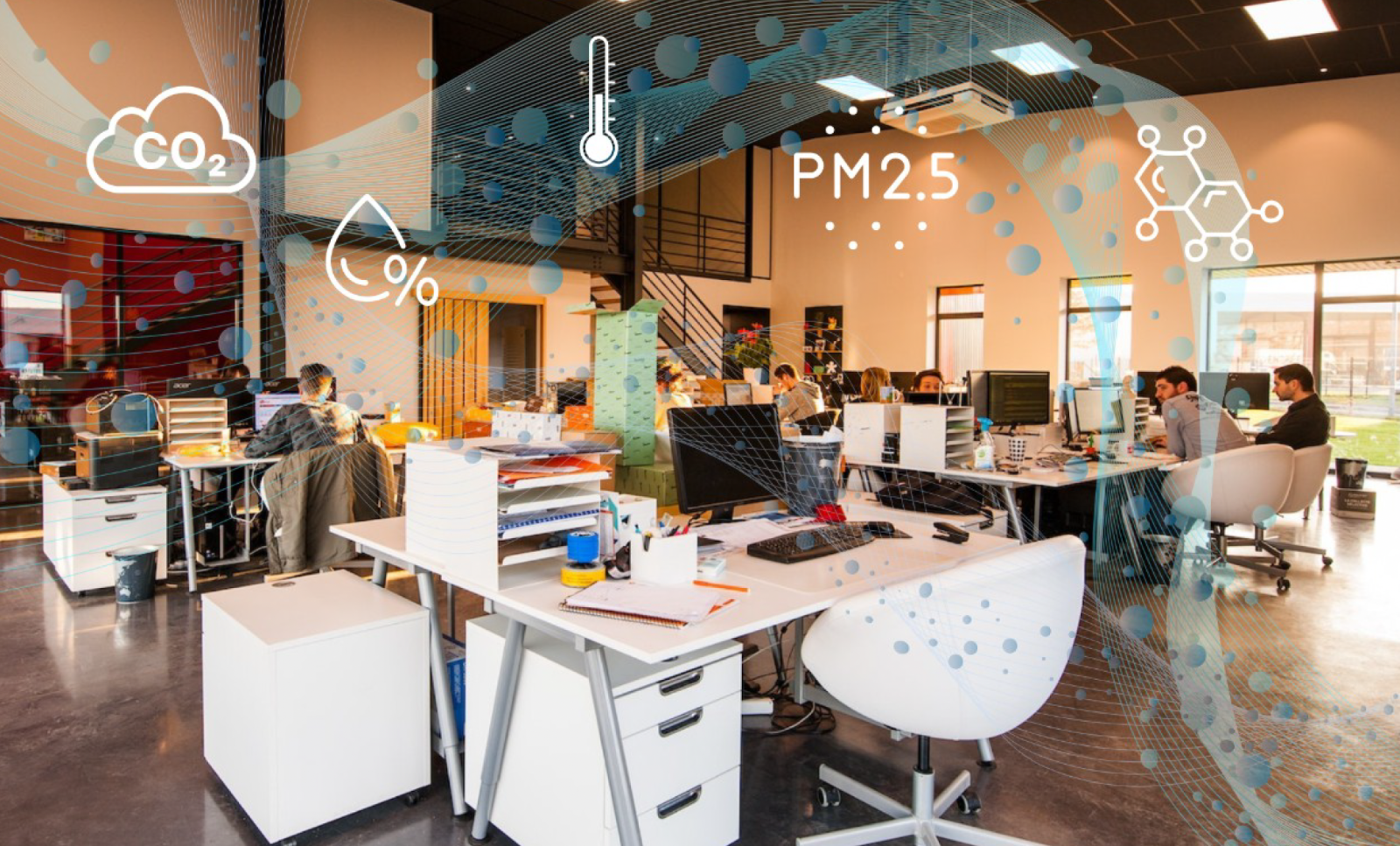
Monitoring indoor air quality in particular can be carried out using specific devices equipped with sensors capable of detecting multiple types of pollution and a varied parameters that can contribute to making indoor air unhealthy, such as:
- electromagnetic fields (high and low frequency);
- PM 2.5 particulate matter (animal hair, dust, pollen, etc.);
- volatile organic compounds (such as formaldehyde);
- carbon dioxide (CO2);
- air temperature (on which the speed and intensity of many volatile components can depend);
- relative humidity below 70%, so as not to encourage microbiological pollution;
- presence of radon gas.
We might think that install sensors in entire buildings with numerous rooms, or many environments located even at great distances from each other, is not so simple. In reality, this is not the case: the use of wireless communication networks with 0G Sigfox technology has allowed the development of sensors that make it easy to apply this strategy. In fact, this technology allows us to have sensors that are extremely small in size, economical, high precision, robust and require no maintenance, thanks, for example, to long-lasting batteries.
The sensors are also simple to install, do not require wiring and can be easily moved from one room to another. They can also be configured according to your needs: for the detection of inorganic gases and volatile organic compounds in the air, rather than to obtain other detailed information on temperature, humidity, etc.
An example: the sensors of 3Castagni and Connected Invention, companies specialized in the development of hardware, firmware, software and turnkey IoT solutions, characterized by being miniaturized, made with components with high longevity and specific for ultra low power, with multiple connectivity, capable of detecting multiple parameters simultaneously (temperature, air quality,…) and RF optimized for space saving without reducing performance.
The link between air quality and energy efficiency
Having air quality and environmental parameters under control allows you to protect human health and the environment, while also pursuing energy efficiency.
Have sensors that precisely measure and monitor indoor air quality allows a quick and accurate dispatch of the recorded values to advanced building management systems, making the overall management of the mechanical ventilation and air conditioning system more efficient.
It has been estimated that by knowing the exact temperatures in each apartment, property owners can save 15-20% of heating and energy costs (source: Connected Inventions).
Environmental detection based on new intelligent devices therefore allows us to improve the comfort and well-being of both people and the environment.
Integrating energy and environmental monitoring is possible thanks to the Internet of Things: this need, combined with precise design techniques and the use of dedicated LPWA communication networks, has allowed us to develop simple and effective solutions for measuring energy and comfort parameters.
In particular, the use of 0G Sigfox wireless communication networks has allowed the development of integrated sensors with low energy consumption and consequent long life battery without increasing size, and ease of installation and management, thanks to the absence of wiring and to the possibility of easily repositioning the sensors in accordance with the possible reorganization of the internal spaces of a building.

Sigfox 0G technology: how it works
In this context, 0G Sigfox technology is an active communication technology that uses a dedicated data collection infrastructure with national coverage. It is characterized by:
- long reading distances
- low electromagnetic emissions
- robustness and high energy efficiency
- allows you to collect a large variety of data from the field, updated and usable remotely, for the collection of which it is no longer possible to rely just on solutions based on traditional communication technologies such as cellular.
Unlike short-range technological solutions (BLE, RFId, etc.), which provide a good solution for collecting data in limited spaces, Low Power Wide Area Network (LPWA) connectivity allows huge distances to be covered. Specifically, low-power LPWA networks, to which Sigfox also belongs, are becoming a reference point for the technological evolution of the IoT world.
Based on the Sigfox Ultra Narrow Band (UNB) communication protocol, 0G technology provides numerous advantages over traditional communication networks. Among these, we mention:
- simplicity of use
- low cost
- low energy consumption
- security
- absence of electromagnetic pollution.
It guarantees coverage in Italy and ensures global interoperability for its customers integrating with the networks of all Sigfox operators who use the same standard as 0G communication present in over 70 countries around the world. And there is no need to invest in hardware: thanks to the presence of an operator, users will not have to worry about network-related issues.
The protocol allows data to be brought into the cloud using a new network dedicated to the IoT and not through the classic mobile telephone or WiFi networks. The communicating object in Sigfox is not connected to a specific base station, but the sent message is received by all base stations located in the area reached by the signal. With Sigfox data can be transmitted even over large communication distances, guaranteeing high network scalability, thanks to signal penetration and the high number of managed nodes.
Conclusions
In a constantly evolving world where energy and environmental monitoring is fundamental for the health of human beings and the planet, technology plays a key role in obtaining visibility and control of processes.
To this end, EIT Smart, a company of the EI Towers Group, is able to implement solutions to collect a large variety of data from the field, updated and usable remotely, making available a unique and highly innovative technology: 0G Sigfox technology, which enables applications that until recently would not have been sustainable with traditional technologies.
For more info write to info.eitsmart@eitowers.it.
