


Article by Rémi Lorrain
Vice-president Convergence – UnaBiz
How to implement convergence between Sigfox and LoRaWAN devices?
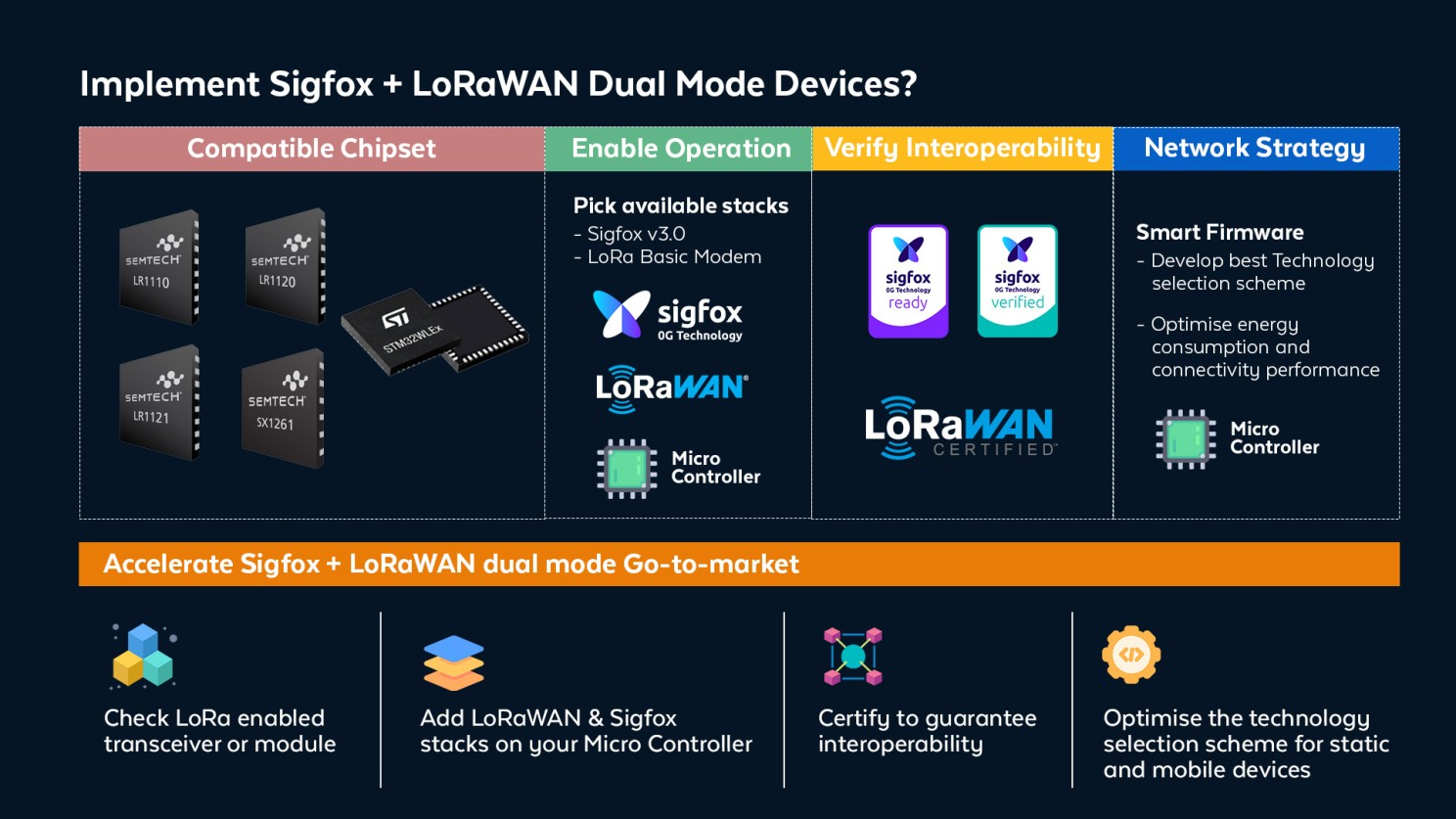
The most frequently asked question about convergence is: How can you implement convergence between Sigfox and LoRaWAN devices?
One of the most frequent questions users ask about convergence is: “How can convergence be implemented between Sigfox and LoRaWAN devices/solutions?”.
There are several stakeholders in the IoT ecosystem who have already undertaken what we could call “hybridization”, i.e. the implementation of hybrid schemes in their IoT devices. This process has often been reinterpreted by each player depending on the sector in which it operates, introducing barriers to achieving a rapid go-to-market strategy and emphasizing the vertical integration of applications.
The goal of this article is to share an easy way to implement Sigfox and LoRaWAN dual-mode functionality on your devices.
Who is the target audience?
First of all, who is the target audience? Which company finds value in implementing Sigfox + LoRaWAN dual-mode devices/solutions and why?
1. Device manufacturers: Convergence increases the cost-effectiveness of their product portfolio by enabling access to a broader market with a single product (SKU) capable of communicating with both technologies (Adeunis, Connected Inventions, Itron Sigfox and LoRa meter, Kaifa and Unabiz)

2. IoT Service Providers: Convergence allows them to expand their coverage with a single IoT device/solution (API-K)
3. IoT customers (companies): end users who wish to exploit the same IoT device by connecting it from time to time to the best network, LoRaWAN or Sigfox, available depending on the geographical areas, thus avoiding running risks when the chosen network experiences interruptions or is unavailable (for example, international asset tracking with mobile devices that need the best coverage available where they are used).
What are the benefits for IoT customers in adopting LoRaWAN and Sigfox dual mode?
• Expanded coverage, including LoRaWAN satellite access by Sigfox and LoRaWAN customers in multiple geographies;
• Single device (SKU) for both technologies to reduce costs;
• Improved SLA and network performance/resilience when Sigfox and LoRaWAN are deployed simultaneously.
What triggered the ability to scale the Sigfox and LoRaWAN dual-mode deployment?
Semtech now supports dual mode on 2nd and 3rd generation chipsets in the LoRa Connect and LoRa Edge portfolios in collaboration with Semtech and Unabiz.
What is the easy-to-follow process to implement Sigfox and LoRaWAN dual mode?
Step 1: choose a compatible chipset from the following:
1. Semtech LR1110 LR1120, LR1121 , SX126x
2. ST Micro STM32WL5
3. IoT modules Murata LoRaWAN Modules LSM 110A
Step 2: integrate Sigfox and LoRaWAN opensource firmware onto the device’s external microcontroller
- Sigfox end point library
- LoRa Basics Modem stack for Semtech chipsets
- Enable Sigfox on LRxx Semtech Chipsets
*The Sigfox implementation diagram on Semtech’s SX12xx chipsets will be released on Github by the end of 2023.
Step 3: integrate, certify and test the entire software package
- Adapt the selected microcontroller
- Certify radio and protocol (LoRaWAN certification, Sigfox certification)
- Manage your device’s Sigfox and LoRaWAN credentials
- Integrate and test
Step 4: Update the device application firmware (on edge) and/or IoT cloud middleware with the best “technology selection scheme”, adapted to your use case:
- Choose the best available network connectivity (Sigfox or LoRaWAN) during provisioning if the device is static (switch to the best available network connectivity)
- or dynamically choose the best available connectivity if the device is mobile (each transmission searches for the best available network connectivity)
- or connect Sigfox and LoRaWAN at the same time (network overlay) to increase network capacity and resilience.
The selection of smart network technology can be implemented on the edge (device firmware) or in the cloud (middleware for data extraction, for example: UnaConnect or application server).
If you have any questions or difficulties with hybridizing your devices/solutions, please contact us at info.eitsmart@eitowers.it
